
Smart trainers are the one piece of indoor gear that I really care about during the winter season. They turn dark evenings into structured training time, and a bad one can sour the whole experience — inconsistent power numbers, dropouts mid-interval, ERG mode that hunts wildly when you change cadence. I have been through a few. This past winter I retired my Zwift Hub and replaced it with the CYCPLUS R200, a direct-drive trainer that sells for under $400 with a claimed 2,200 W ceiling and ±1% power accuracy. After a full season on it across both Zwift and MyWhoosh, I have a clear picture of where it shines and the one area where it falls short of its predecessor.
What you get for the money
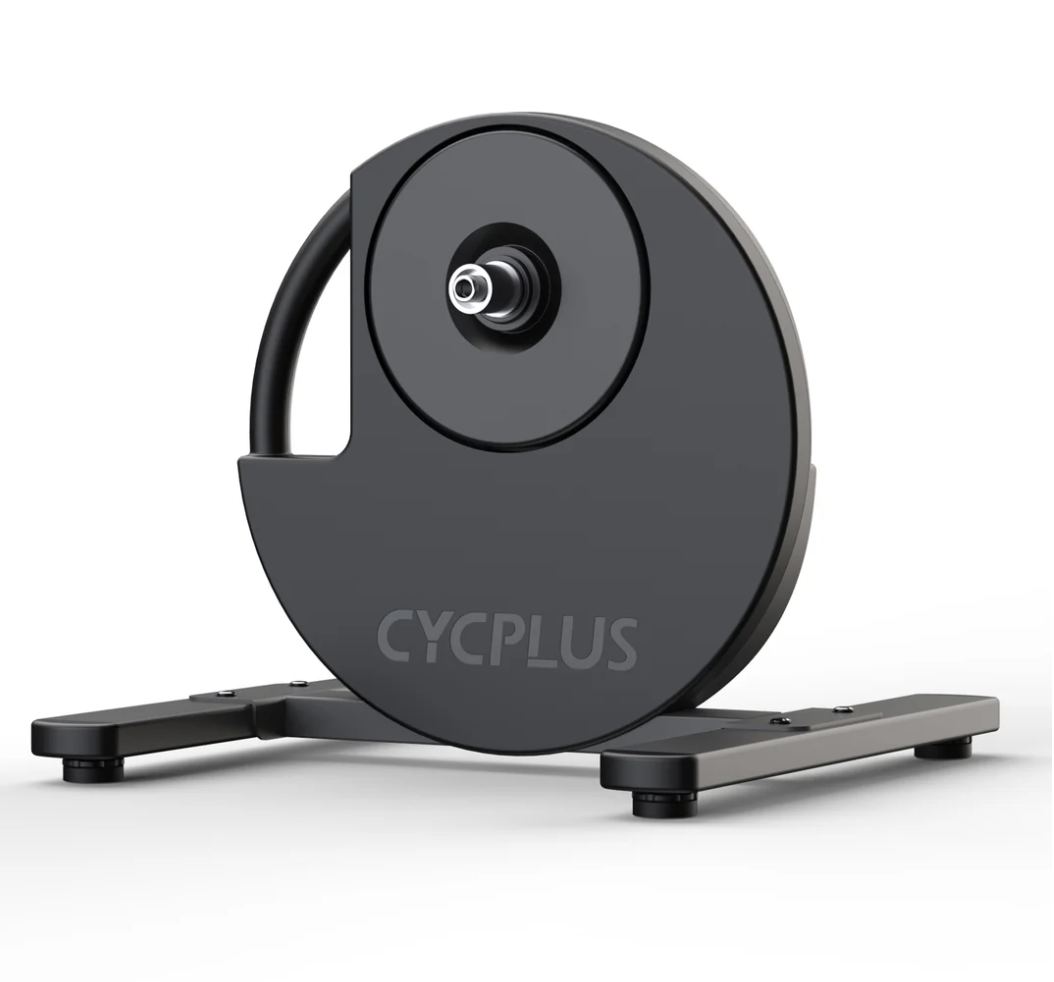
The R200 is a direct-drive trainer, which means your rear wheel comes off and the bike bolts directly onto the unit via a cassette. That alone puts it in a different category from wheel-on trainers — better accuracy, no tyre wear, and no slippage when you sprint. The headline numbers are competitive with trainers that cost considerably more. Maximum power is 2,200 W, gradient simulation goes up to 19%, peak torque is 80 Nm, and power accuracy is rated at ±1%. The unit weighs 13.5 kg, supports riders up to 120 kg, and has a footprint of just 0.27 m² — small enough to live in a corner of an apartment without dominating the room.
Freehub options are available for Shimano HG, SRAM XDR, and Campagnolo at order. I went with the HG version and dropped a cheap 11-speed cassette on it. Connectivity is the standard pairing of Bluetooth and ANT+ with FE-C support, which means it works with every major training platform — Zwift, MyWhoosh, TrainerRoad, Kinomap, FulGaz — without any compatibility shenanigans. There is also a clever detail: the trainer can run without being plugged into the wall, generating its own power from your pedalling. I have not actually used this in practice — my pain cave has a socket — but it is a neat option for anyone setting up in an awkward location.
The road and ride feel on Zwift and MyWhoosh
I started my winter uwing Zwift, however the continuous up-creep of the monthly subscription led me to try MyWhoosh, which is what I have used ever since. The R200 paired instantly with both and behaved exactly as expected — gradients felt accurate, sprints felt punchy, and group rides held a steady connection across multi-hour sessions. The 19% gradient ceiling is more than enough for anything Zwift throws at you, including the ever so popular Alpe du Zwift. I never felt the resistance run out on a climb.
Direct-drive trainers under $400 used to feel notably worse than the $1,000+ class. That gap has closed. Hard efforts feel solid and planted. Standing climbs do not produce the side-to-side wobble that cheaper trainers sometimes have. The flywheel inertia is well-judged — there is enough mass that coasting feels natural and you do not get that abrupt sensation of the resistance vanishing the moment you stop pedalling. It is not a Tacx Neo, but it is also a small fraction of the price.
If you are someone who flips between platforms — and an increasing number of indoor riders are, given that MyWhoosh is free — the R200 plays nicely with both without any quirks I noticed.
How it compares to the Zwift Hub
The Zwift Hub was always the obvious recommendation for anyone wanting a direct-drive trainer without spending Kickr money. It is well built, accurate, quiet, and comes with a cassette pre-installed. The R200 is competitive on accuracy (both are rated ±1%), competitive on power ceiling (the R200 actually wins on paper at 2,200 W versus the Hub's 1,800 W), and competitive on price. Where the Zwift Hub still wins is noise — meaningfully so — and the included cassette is a nice touch that saves you a small amount on initial setup.
Where the R200 wins is gradient simulation (19% versus 16%), maximum power, and a slightly more responsive ERG mode in my experience. Build quality on the R200 also feels marginally more substantial — the metal frame is sturdier, and the footprint is a touch smaller. Neither trainer is a wrong choice. If absolute quiet is your priority, the Hub remains the better pick. For everything else, the R200 either matches or exceeds it at a similar price.
Reliability after a full season
This is the part of any smart trainer review that I think matters most, and it is the one that gets glossed over in first-impression pieces. I have ridden the R200 through a full winter — somewhere north of 2,000 km of indoor riding, including weekly long Zwift rides, structured FTP blocks, and several race events on MyWhoosh. In that time I have had zero issues. No dropouts. No firmware bricks. No calibration drift that I could detect. No bearing noise emerging. No connectivity flakiness. It has been completely uneventful, which is exactly what you want from a smart trainer.
Who this trainer is for
If you are looking for your first direct-drive smart trainer and you do not want to spend over a thousand on a Kickr or Neo, the R200 is a serious contender. It is accurate, well built, compatible with every platform that matters, and has held up reliably across a full season of hard use. The noise level is the one place it falls behind the Zwift Hub, and if that matters to you specifically, factor it in. For everything else, the R200 delivers what entry-level direct-drive trainers used to charge twice as much for. After a winter on it, I have no regrets about the swap.




Comments
No comments yet. Be the first to share your thoughts!
Leave a Comment